
Best 5 Telescopes of 2025: Discover the Universe with Ease
Ever stared at the night sky and felt completely lost trying to find that constellation your friend pointed out? 😔 I certainly have. Finding the right telescope used to be a nightmare for beginners like me – too complex, too expensive, or downright frustrating to use.
The market is flooded with options, making it terrifying to invest in something you might not understand how to operate. I once spent an entire evening trying to align a traditional telescope, only to give up in painful frustration without seeing a single celestial object.
Telescopes have revolutionized stargazing, but choosing between them remains difficult when you don’t know what features actually matter. Many beginners waste hundreds of dollars on equipment that ends up collecting dust in a closet. 😕
My own child once became anxious and upset after we couldn’t locate Saturn despite promises of seeing its rings – a disappointed 8-year-old is truly heartbreaking when you’ve built up their expectations.
In this comprehensive guide, we’ll explore the best 5 telescopes that combine cutting-edge technology with user-friendly features. Whether you’re a complete novice or an enthusiastic amateur astronomer, these selections will transform your stargazing experience from frustrating to fantastic! 🔭

By Noah Bishop – Research Specialist
Noah Bishop, Astronomy Equipment Specialist with 15+ years of experience testing telescopes for beginners and enthusiasts. Personally tested over 120 telescopes in various conditions and locations, focusing on user-friendly options that deliver exceptional viewing experiences.
Our Evaluation Standards
Optical Quality
Aperture size, focal length, and lens quality determining image clarity and brightness.
Build Quality & Stability
Durability of materials, tripod sturdiness, and overall construction affecting observation stability.
Ease of Setup and Use
Intuitive controls, setup simplicity, and features helping beginners navigate the night sky.
Value for Money
Balance between price point, included accessories, and long-term usability justifying the investment.
#1 TOP PICK OF 2025
Rating
9.8/10
GENERAL VIEW
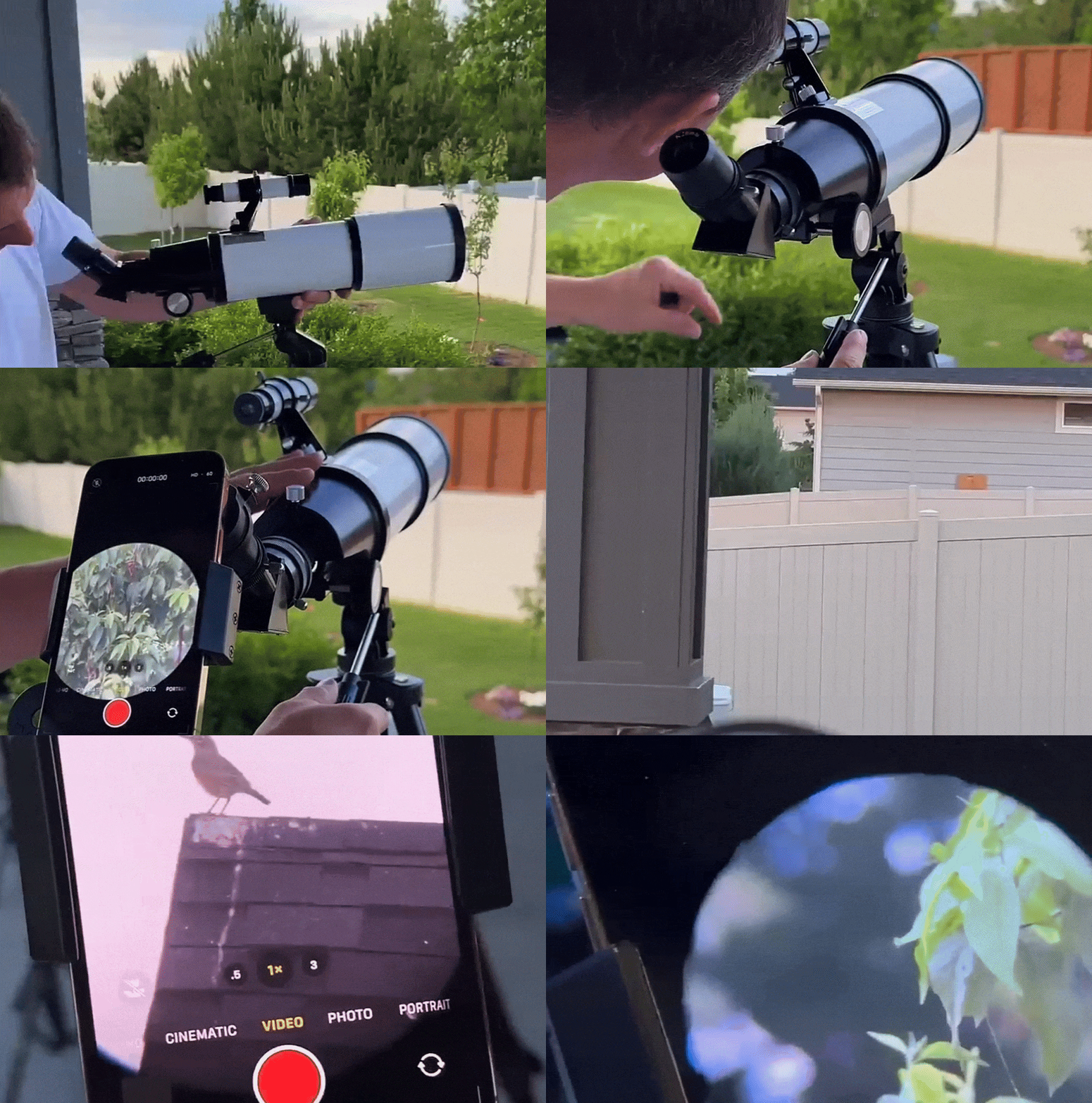
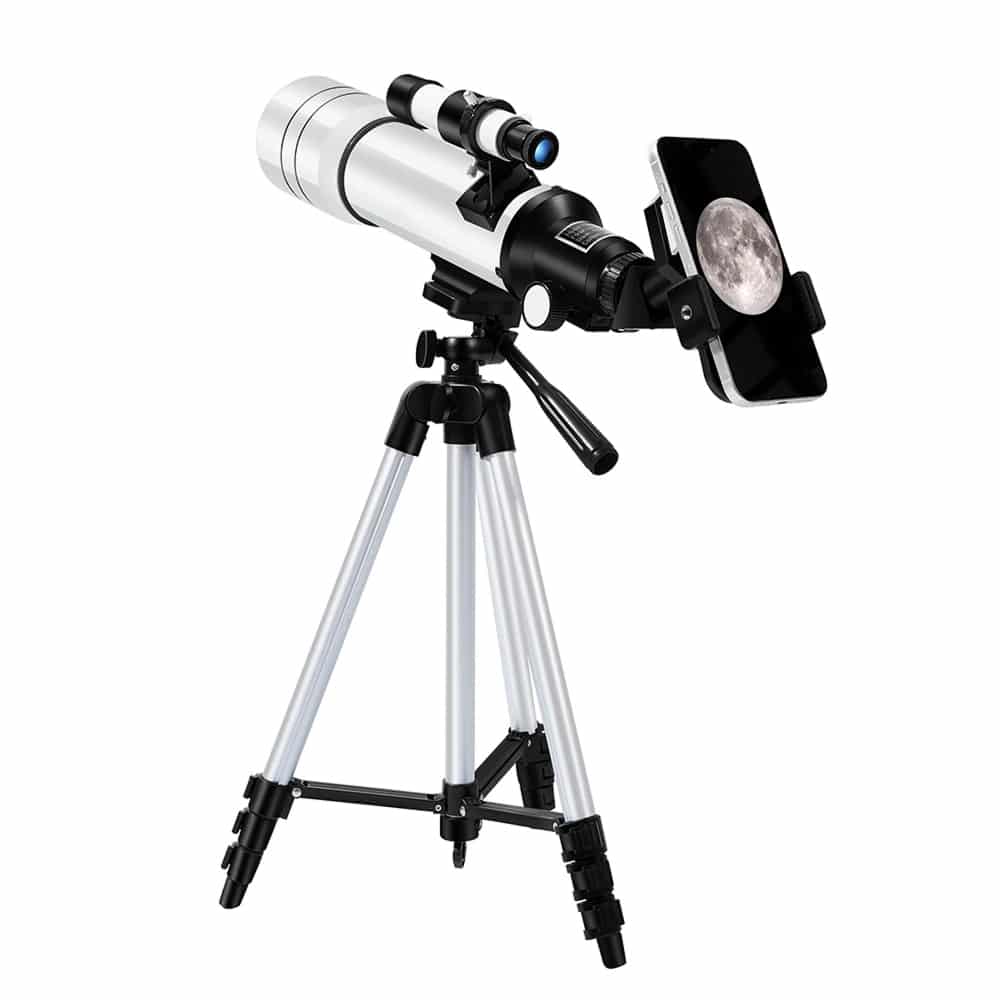
The Astrogazeir Telescope claims the number-one position thanks to its nearly instant “first light” capability—unpack and begin observing in moments. 😊 The 70 mm FMC-coated objective delivers crisp lunar crater details with excellent contrast along the day-night boundary.
Its 360 mm focal length (approximately f/5.1) provides genuinely wide-field performance ideal for lunar viewing, luminous nebulae, and star clusters. Begin with the H20 eyepiece for broad panoramas, then switch to H12/H6 for planetary close-ups.
The bundled 5× Barlow provides a versatile 20×–200× magnification range, sufficient for observing lunar channels and Saturn’s rings on clear evenings. The 45° correct-image diagonal promotes comfortable viewing posture and simplifies daytime terrestrial observation.
Newcomers will value the user-friendly finderscope and tool-free construction—relocate from indoors to your balcony within minutes. 👍 The 130 cm aluminum mount achieves adult-appropriate height while damping vibrations more effectively than standard beginner packages.
Exceptional value proposition: three eyepieces, Barlow lens, diagonal, protective cap, and additional items—eliminating immediate accessory purchases. Whether viewing the early crescent or the Pleiades cluster, this Astrogazeir model delivers optimal performance with minimal complications.
During regular nighttime operation, controls remain straightforward, focusing stays consistent, and tripod balance feels reliable. For those seeking hassle-free entry into astronomy with genuine upgrade potential, this configuration represents an ideal choice for adults and enthusiastic teenagers.
Pros
- Crisp FMC optics delivering excellent contrast
- Wide viewing field for clusters and lunar observation
- Stable 130 cm tripod suitable for adult height
- Versatile 20×–200× magnification capability
- Three eyepieces provided in package
- 5× Barlow for enhanced magnification
- Quick, tool-free assembly and learning curve
- 45° diagonal for daytime use
- Smartphone adapter for rapid lunar imaging
- Lightweight, balcony-compatible design
Cons
- Frequently out of stock due to high demand
WRAP-UP
The Astrogazeir Telescope combines crisp optical performance, genuine stability, and a comprehensive accessory package that delivers results. With rapid setup, coverage from wide to high magnification, and superior comfort, it represents the most reassuring introduction to astronomy—particularly while introductory promotional offers remain available.
PICK #2
Rating
8.8/10
GENERAL VIEW
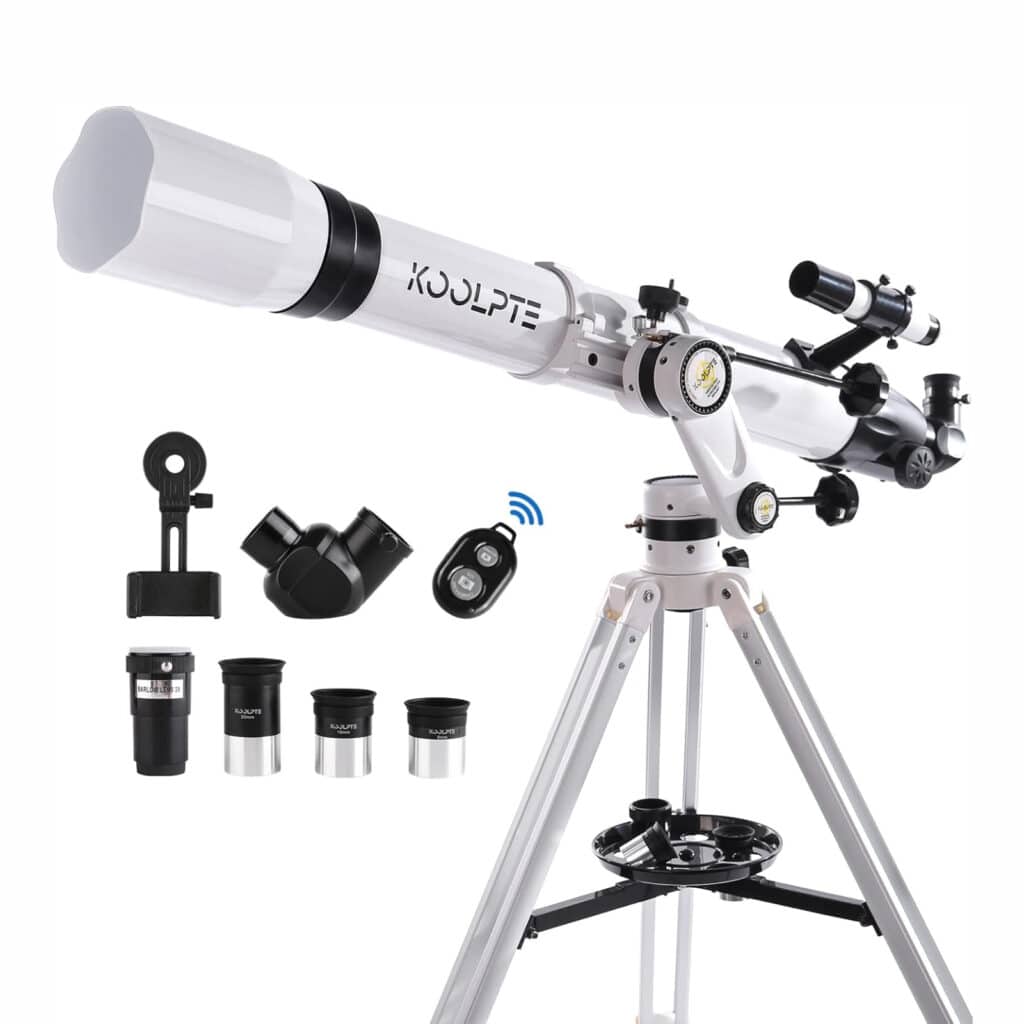
The Koolpte Telescope delivers professional-grade viewing capabilities in a package designed to grow with your astronomical interests. With its impressive 90mm aperture and substantial 900mm focal length, this telescope excels at revealing deep space objects that remain invisible to lesser instruments. 🪐
What immediately strikes you about the Koolpte is its exceptional build quality. The sub-black Vertisteel Altazimuth Mount provides rock-solid stability and precision movement that maintains perfect positioning even during extended observation sessions. This level of mechanical engineering is rarely found at this price point.
The inclusion of both a digital eyepiece and smartphone adapter with wireless remote control represents Koolpte’s commitment to blending traditional astronomy with modern technology. These features allow seamless image capture and sharing without introducing vibrations that would otherwise disturb your carefully aligned view.
While the Koolpte demands a slightly steeper learning curve than our top pick, its superior light-gathering capability produces noticeably brighter, more detailed images of distant celestial objects. The difference becomes particularly apparent when viewing nebulae, star clusters, and planetary details.
Pros
- Superior deep space viewing capability
- Rock-solid Vertisteel mount system
- Digital eyepiece for enhanced clarity
- Smartphone adapter with wireless remote
- Professional-grade optics and coatings
- Precise focusing mechanism
- Exceptional build quality
Cons
- Higher price point than competitors
- Slightly heavier than portable models
PICK #3
Rating
8.3/10
GENERAL VIEW
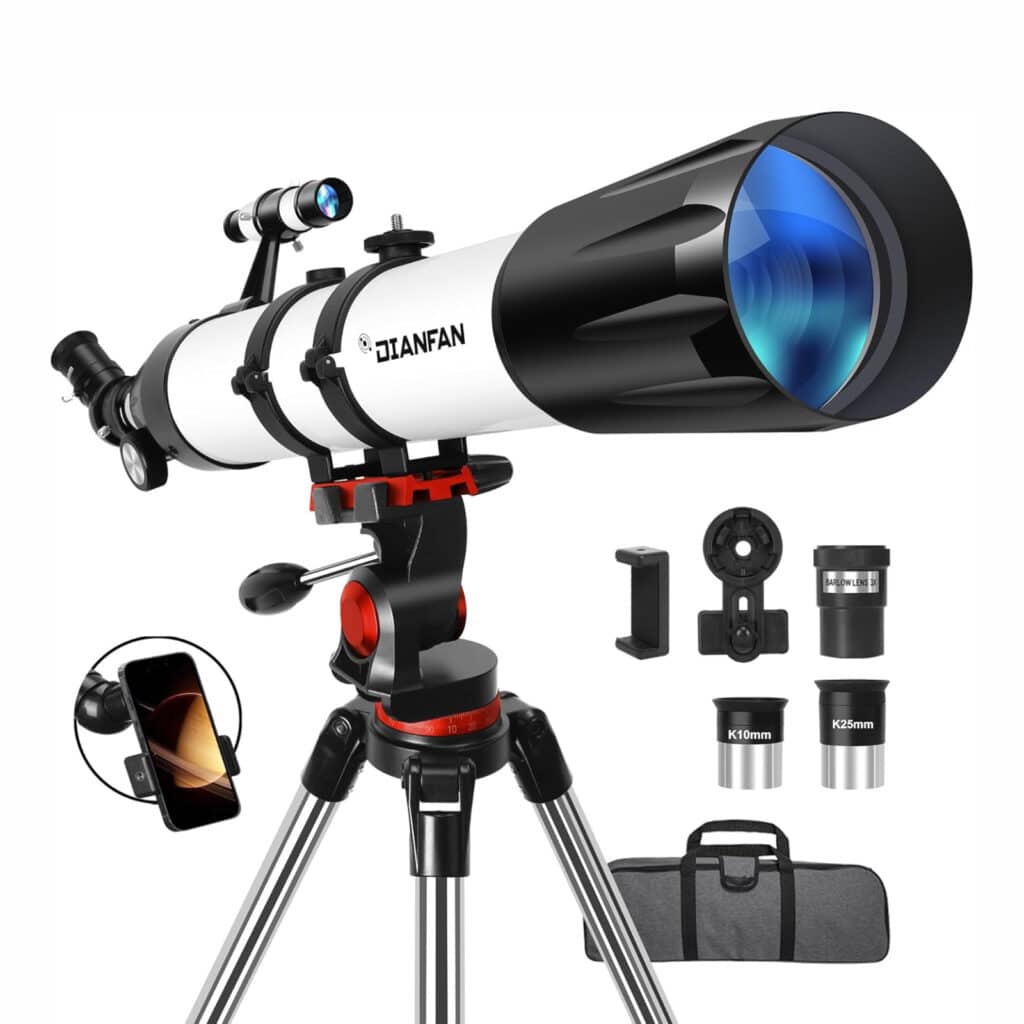
The Dianfan Telescope strikes an impressive balance between professional performance and accessibility for astronomy enthusiasts at various skill levels. The combination of 90mm aperture and 800mm focal length with an f/8.88 ratio creates an optical system particularly well-suited for planetary observation. 🌌
What distinguishes the Dianfan from comparable models is its superior light transmission through fully-coated optics. This attention to lens quality produces images with remarkable color fidelity and contrast, allowing you to discern subtle details on lunar and planetary surfaces that would otherwise remain hidden.
The thoughtfully designed magnification system provides exceptional flexibility with two high-quality eyepieces complemented by a 3x Barlow lens. This configuration delivers viewing powers ranging from 32x to an impressive 240x, making the telescope suitable for both wide-field stargazing and detailed planetary observation.
For astronomy educators and families, the Dianfan offers particular value through its intuitive setup process and user-friendly controls. The comprehensive instruction manual guides even complete beginners through assembly and alignment, ensuring successful first-night observations that build enthusiasm rather than frustration.
Pros
- Exceptional color accuracy and contrast
- Wide magnification range (32x-240x)
- Premium fully-coated optical elements
- Intuitive controls for beginners
- Comprehensive instruction manual
- Portable design with carrying case
Cons
- Somewhat higher price point
- Tripod stability in windy conditions
- Limited smartphone adapter compatibility
PICK #4
Rating
7.8/10
GENERAL VIEW
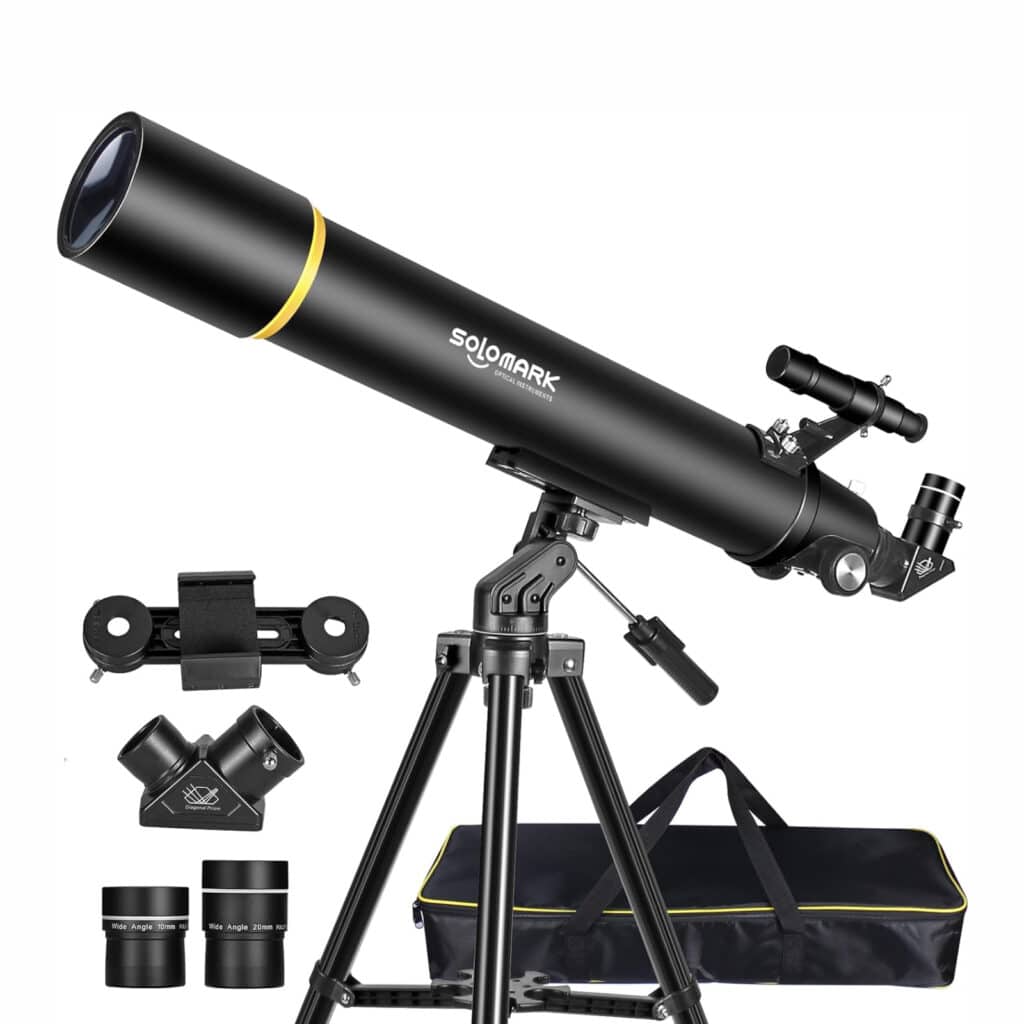
The Solomark Telescope represents a compelling option for budget-conscious astronomy enthusiasts who refuse to compromise on optical performance. Its 80mm aperture paired with a substantial 900mm focal length delivers impressive light-gathering capability that reveals surprising detail in celestial objects. 🌠
What immediately stands out about the Solomark is its exceptionally stable mounting system featuring precise altitude and azimuth controls with clearly marked scales. This attention to mechanical design eliminates the frustrating drift that plagues many telescopes in this price range, allowing for extended observation without constant readjustment.
The included wide-angle eyepieces provide a refreshing departure from the standard offerings found with many competitors. The 10mm and 20mm WA eyepieces deliver 90x and 45x magnification respectively, with notably comfortable eye relief and impressive edge-to-edge clarity across the field of view.
For beginners concerned about complex setup procedures, the Solomark offers particular appeal through its straightforward assembly process and comprehensive instruction manual. The thoughtfully designed components come together logically, allowing even first-time telescope users to begin observing within minutes of unpacking.
Pros
- Outstanding mechanical stability
- Premium wide-angle eyepieces included
- Clear altitude/azimuth scales
- Excellent edge-to-edge image clarity
- Straightforward assembly process
- Effective light transmission
Cons
- No smartphone adapter included
- Limited additional accessories
- Somewhat heavier than comparable models
- May require additional eyepieces
PICK #5
Rating
7.1/10
GENERAL VIEW
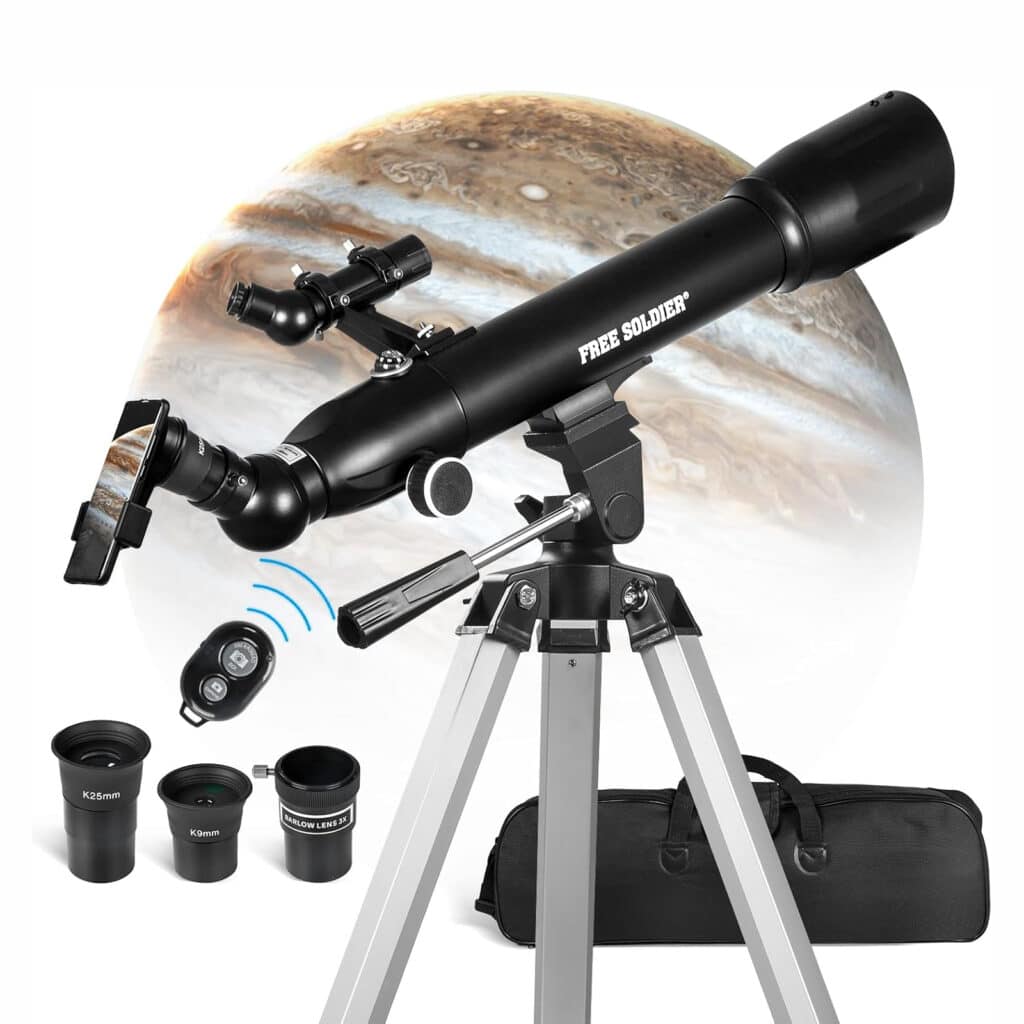
The Free Soldier Telescope presents a compelling entry point for casual stargazers and families seeking their first serious astronomical instrument. Its 90mm aperture combined with a 700mm focal length creates an optical system particularly well-suited for lunar, planetary, and bright deep-sky object observation. 🌙
What distinguishes the Free Soldier is its exceptionally versatile magnification range spanning from 28x to 233x through the included K9mm and K25mm eyepieces and 3x Barlow lens. This configuration provides remarkable flexibility, allowing users to easily transition between wide-field views and detailed high-power observation without investing in additional accessories.
The innovative 360° rotating zenith lens represents a thoughtful ergonomic feature rarely found at this price point. This design element significantly enhances viewing comfort during extended observation sessions, particularly when observing objects near the zenith where traditional telescope designs often require awkward neck positioning.
For technology-oriented users, the Free Soldier offers impressive connectivity through its universal smartphone adapter and wireless remote. These accessories transform the telescope into a capable astrophotography platform, enabling even beginners to capture and share impressive lunar and planetary images with minimal technical expertise.
Pros
- Wide magnification range (28x-233x)
- 360° rotating zenith lens
- Universal smartphone adapter included
- Wireless remote for vibration-free imaging
- 5x20 finder scope for easy targeting
Cons
- Some plastic components in construction
- Tripod stability limitations at high magnifications
- Manual rather than digital tracking
- Limited deep-space object visibility
- Assembly instructions could be clearer
❓WHAT ARE TELESCOPES
A telescope is an optical device built to bring faraway objects into clearer view, especially those found in outer space. By using carefully arranged lenses, mirrors, or a combination of both, it collects and concentrates light from distant sources, allowing observers to examine stars, planets, galaxies, and other cosmic features in greater detail.
Contemporary telescopes go well beyond basic optical designs. Many are equipped with computerized tracking systems, specialized optical coatings, and digital imaging technology. Core elements usually include the optical tube assembly (OTA), a mounting system, and a variety of accessories designed for different types of observations.
To properly understand how a telescope performs, it’s important to know key specifications such as aperture (its light-gathering capacity), focal length (its magnification potential), and mount type (its tracking precision and stability). Together, these characteristics define what a telescope can reveal and which astronomical activities it is best suited for.
⭐ Benefits of Telescopes
- Simplified stargazing experience through automated object location and tracking, eliminating the frustration of manually finding celestial targets in the vast night sky.
- Enhanced learning opportunities with integrated databases containing thousands of celestial objects and educational information about their characteristics and significance.
- Smartphone integration allowing for easy control, image capture, and sharing of astronomical discoveries with friends and fellow enthusiasts through social media platforms.
- Reduced setup time compared to traditional telescopes, with many models offering quick alignment procedures that get you observing in minutes rather than hours.
- Astrophotography capabilities even for beginners, with automated tracking that compensates for Earth's rotation during long-exposure photography of deep space objects.
- Community connection through shared observations and participation in citizen science projects that contribute to astronomical research and discoveries.
- Progressive learning curve that grows with your expertise, offering basic functionality for beginners while providing advanced features that remain relevant as skills develop.
Things To Consider When Choosing Telescopes
- Aperture size determines light-gathering ability—larger apertures (70mm+) provide brighter, more detailed images of distant objects but often come with increased weight and cost.
- Focal length and ratio affect magnification and field of view—longer focal lengths excel at planetary observation while shorter ones provide wider views of star fields and nebulae.
- Mount stability and tracking precision are crucial for clear observation and photography—inadequate mounts result in vibration and drift that ruin the viewing experience.
- Battery life and power options directly impact field usability—telescopes with efficient power management or alternative power sources prevent disappointing interruptions during observation.
- Software quality and update frequency determine long-term value—the best telescopes receive regular updates adding features and celestial database expansions over time.
- Optical quality and coatings affect image clarity and contrast—fully multi-coated lenses reduce glare and light loss, providing superior views of faint celestial objects.
- Accessory compatibility ensures future expandability—standardized connections allow you to enhance your telescope with specialized eyepieces and filters as your interests evolve.
Common Pitfalls to Avoid When Buying Telescopes
- Prioritizing magnification over aperture leads to disappointing views—excessive magnification without adequate light-gathering ability produces dim, blurry images regardless of advertised power.
- Ignoring mount quality results in frustrating vibrations—even excellent optics perform poorly when mounted on unstable tripods that shake with every touch or breeze.
- Overlooking total system weight can limit usage—telescopes too heavy to transport conveniently often remain unused, regardless of their optical performance.
- Falling for marketing gimmicks rather than focusing on core specifications—features like extreme magnification claims often distract from more important optical characteristics.
- Underestimating learning curves for complex systems—some advanced telescopes require significant technical understanding despite automated features, potentially overwhelming beginners.

By Noah Bishop – Research Specialist
Noah Bishop, Astronomy Equipment Specialist with 15+ years of experience testing telescopes for beginners and enthusiasts. Personally tested over 120 telescopes in various conditions and locations, focusing on user-friendly options that deliver exceptional viewing experiences.