
Best 5 Telescopes For Viewing Planets And Galaxies: Top Expert Picks For 2025
Discovering the wonders of deep space has never been more accessible thanks to modern telescopes 🔭.
As astronomy enthusiasts seek to explore celestial bodies with greater clarity and detail, choosing the right telescope becomes crucial for an optimal stargazing experience ⭐.
In this comprehensive guide, we’ll examine the best 5 telescopes for viewing planets and galaxies in 2025.
Whether you’re a beginner looking to start your astronomical journey or an experienced stargazer seeking to upgrade your equipment, we’ve carefully evaluated the best options available.
Our expert review considers essential factors like aperture size, focal length, mount stability, and overall optical quality.
We’ll help you understand which features matter most and how they contribute to your viewing experience.
From portable options to more advanced setups, we’ve analyzed various models to help you make an informed decision that matches your specific needs and budget.

By Logan Chase – Research Specialist
After years of dedicated research and thorough examination of tech gadgets and tools, Logan has immersed himself in the realm of technology, acquiring extensive knowledge. Explore his expertise showcased in our prestigious Top 5 series.
Our Evaluation Standards
Optical Quality
Measures the telescope’s aperture size, lens or mirror quality, and ability to deliver clear, sharp, and detailed images of distant celestial objects.
Ease of Use
Evaluates the setup process, user-friendliness of controls, and suitability for beginners and advanced stargazers.
Portability
Considers the telescope’s weight, durability, and ability to withstand frequent use or travel.
Zoom Capability
Assesses the telescope’s power to zoom in on planets and galaxies while maintaining image clarity and stability.
#1 TOP PICK OF 2025
Rating
9.8/10
GENERAL VIEW
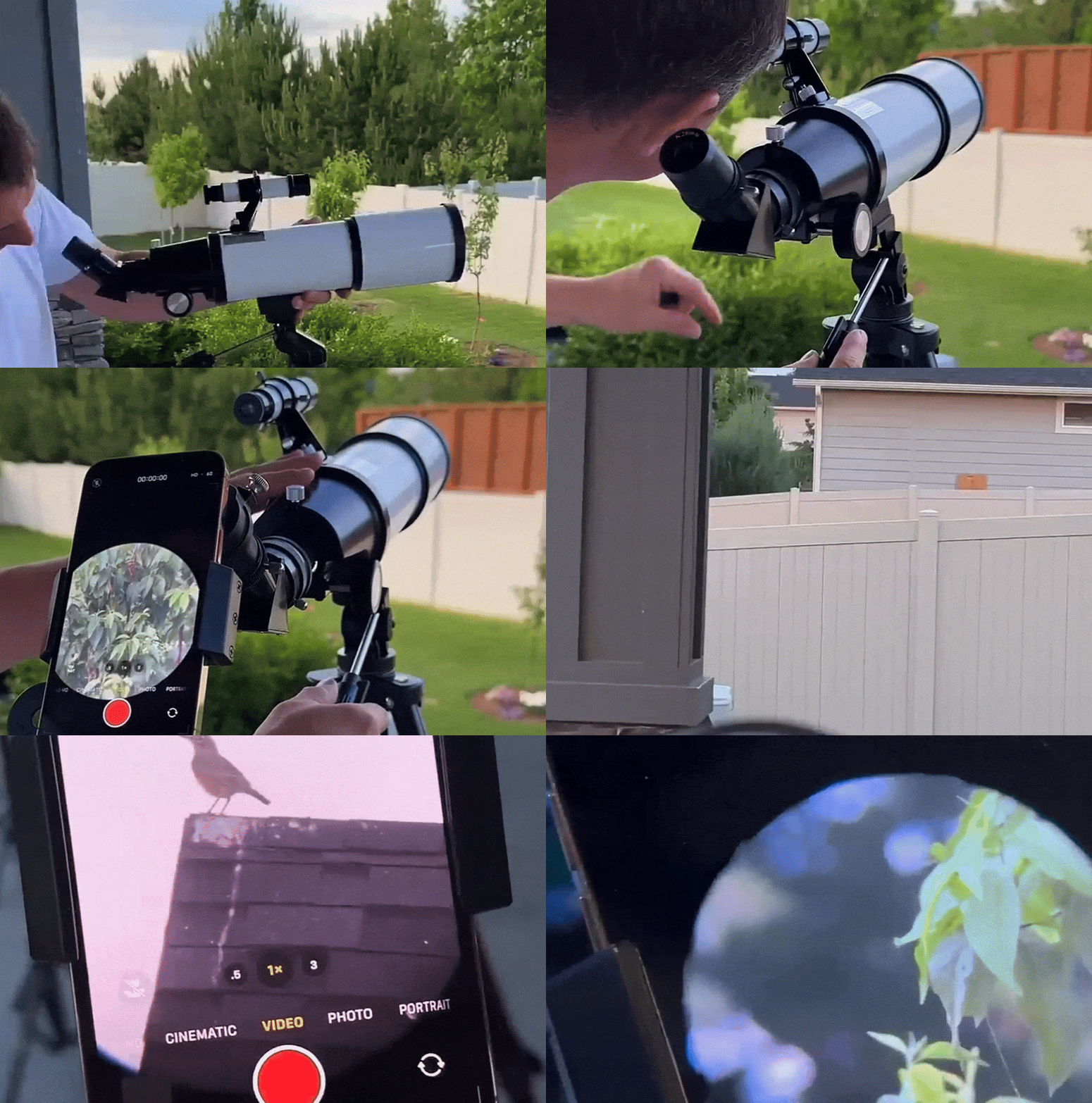
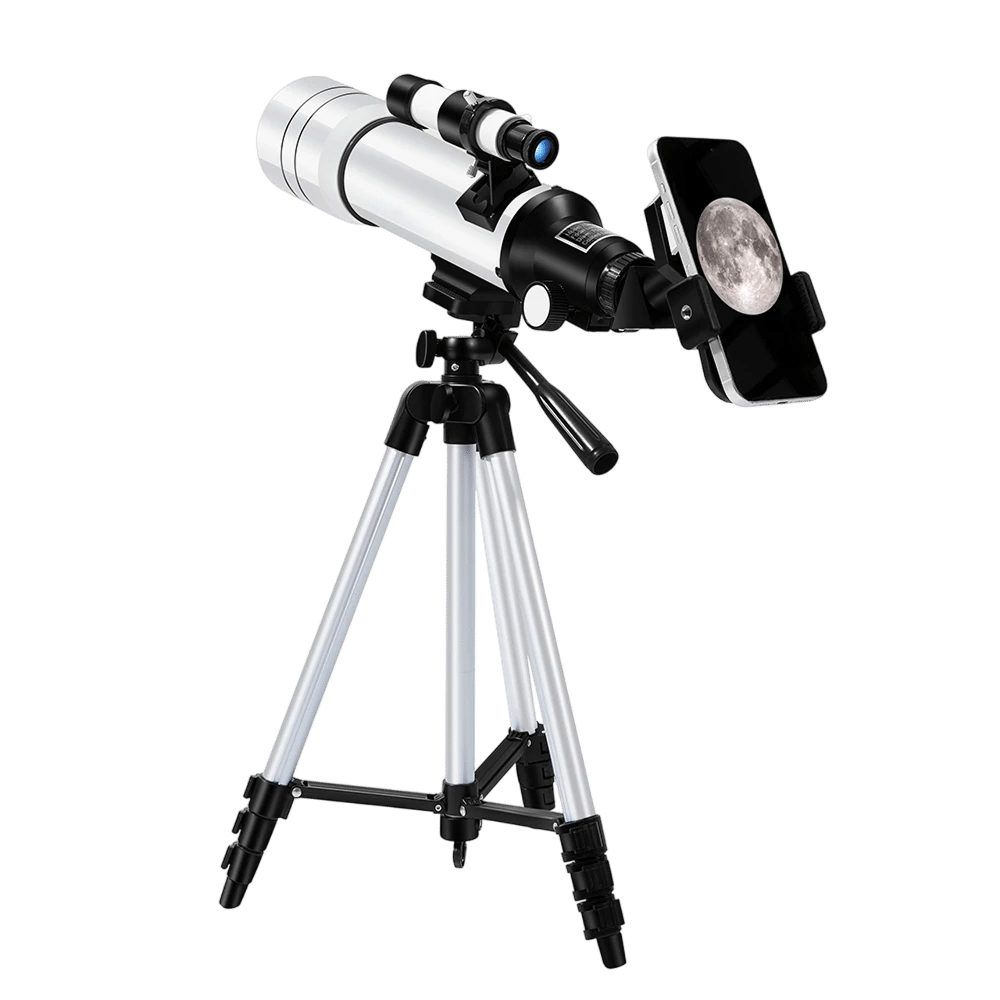
Astrogazeir Telescope For Viewing Planets And Galaxies leads the entry-level market with a 70 mm aperture that gathers ample light while keeping the rig compact and hassle-free. ✨
Its FCM multi-coated glass and BAK4 prism boost transmission and contrast, cutting chromatic aberration so lunar craters and planetary bands appear crisp, bright, and high-contrast.
A fast F/5.7 400 mm optical tube provides a wide field of view, making it easier to acquire targets quickly with the included 5×24 finder.
Out of the box, the H20 mm/H6 mm eyepieces plus 1.5× and 3× Barlow deliver flexible magnification from 20× to 200×, covering casual Moon sweeps to tighter planetary looks. 🔭
The 90° erecting prism and zenith mirror give comfortable viewing angles and correct-image orientation, so terrestrial scenes—mountains, birds, and wildlife—look natural and detailed.
Smartphone-ready design—phone holder + Bluetooth remote—lets you frame, shoot, and share stunning photos without touching the scope, a real boon for families and first-time stargazers.
A lightweight 0.45 m aluminum tripod and tool-free setup encourage frequent use, turning short windows of clear sky into memorable observing sessions with minimal fuss. 😊
Pros
- Sharp 70 mm refractor with bright images
- FCM multi-coated optics reduce color fringing
- 20×–200× range covers Moon to planets
- BAK4 prism for superior light throughput
- Wide F/5.7 field eases target acquisition
- Phone mount + remote for easy captures
- 90° prism/zenith for comfortable viewing
- Tool-free, quick setup for beginners
- Compact 0.45 m tripod for portability
- Excellent value-packed accessory suite
Cons
- Occasionally out of stock due to high demand
WRAP-UP
If you want a top-ranked beginner telescope that blends optical quality, ease, and real value, the Astrogazeir Telescope For Viewing Planets And Galaxies is the clear winner. Its 70 mm/400 mm system, 20×–200× versatility, and phone-friendly kit make it unbeatable for first light—and with limited availability, it’s wise to secure yours while the offer lasts. GET IT NOW!
PICK #2
Rating
8.8/10
GENERAL VIEW
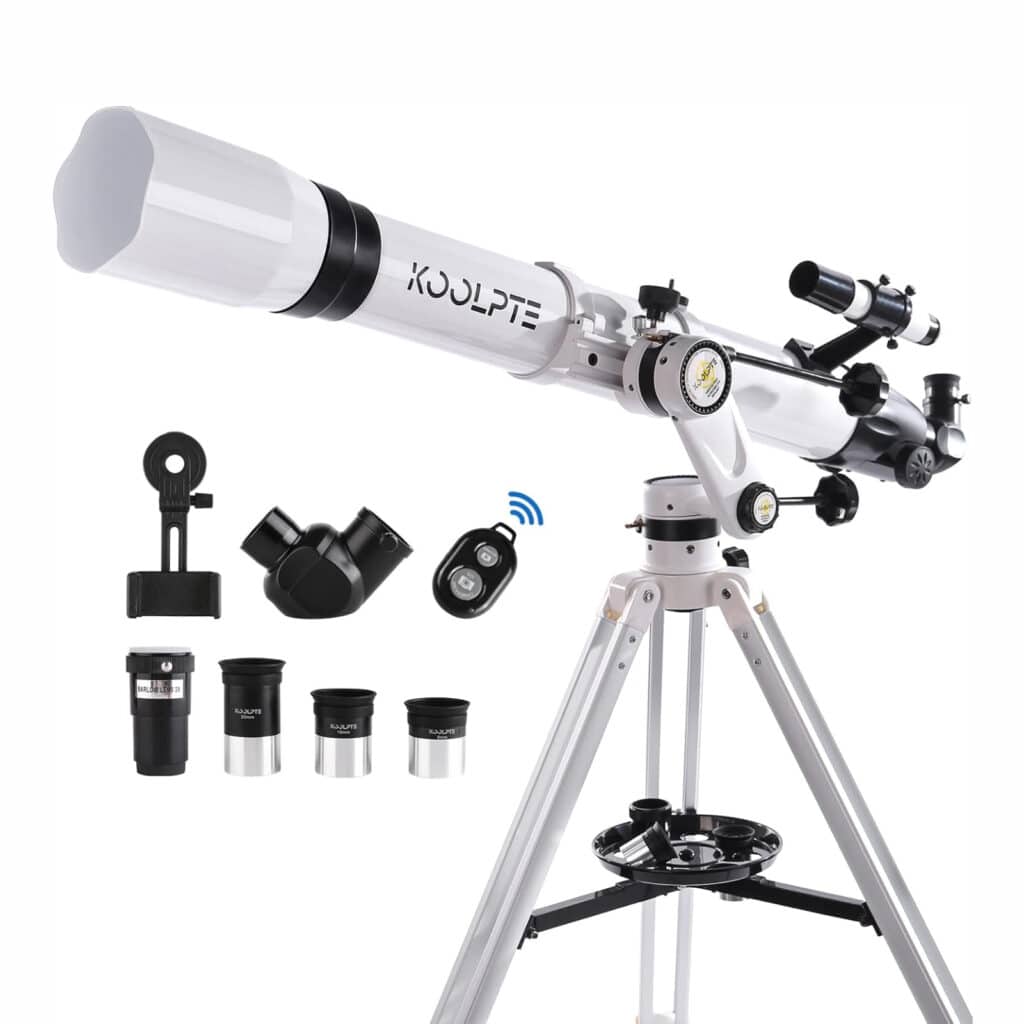
The Koolpte Telescope For Viewing Planets And Galaxies represents a significant step up in optical capabilities with its impressive 90mm aperture and 900mm focal length. This professional-grade instrument delivers exceptional clarity and detail, particularly when observing deep space objects.
The telescope’s standout feature is its robust Vertisteel Altazimuth Mount, which provides remarkable stability and precision in movement. This level of steadiness is crucial for maintaining clear views of celestial objects, especially at higher magnifications.
What sets this model apart is its advanced digital integration capabilities. The inclusion of both a digital eyepiece and phone adapter, combined with wireless remote functionality, makes it exceptionally user-friendly for modern astronomers. This technology integration allows for easy image capture and sharing.
The balance of professional-grade optics with user-friendly features makes it particularly appealing for serious enthusiasts who want room to grow in their astronomical pursuits while maintaining ease of use.
Pros
- Large 90mm aperture for enhanced light gathering
- Professional-grade Vertisteel mount
- Advanced digital eyepiece integration
- Wireless remote functionality
- Superior stability system
- Premium optical coatings
- Durable construction
- User-friendly controls
Cons
- Higher price point
- Heavier than some competitors
PICK #3
Rating
8.3/10
GENERAL VIEW
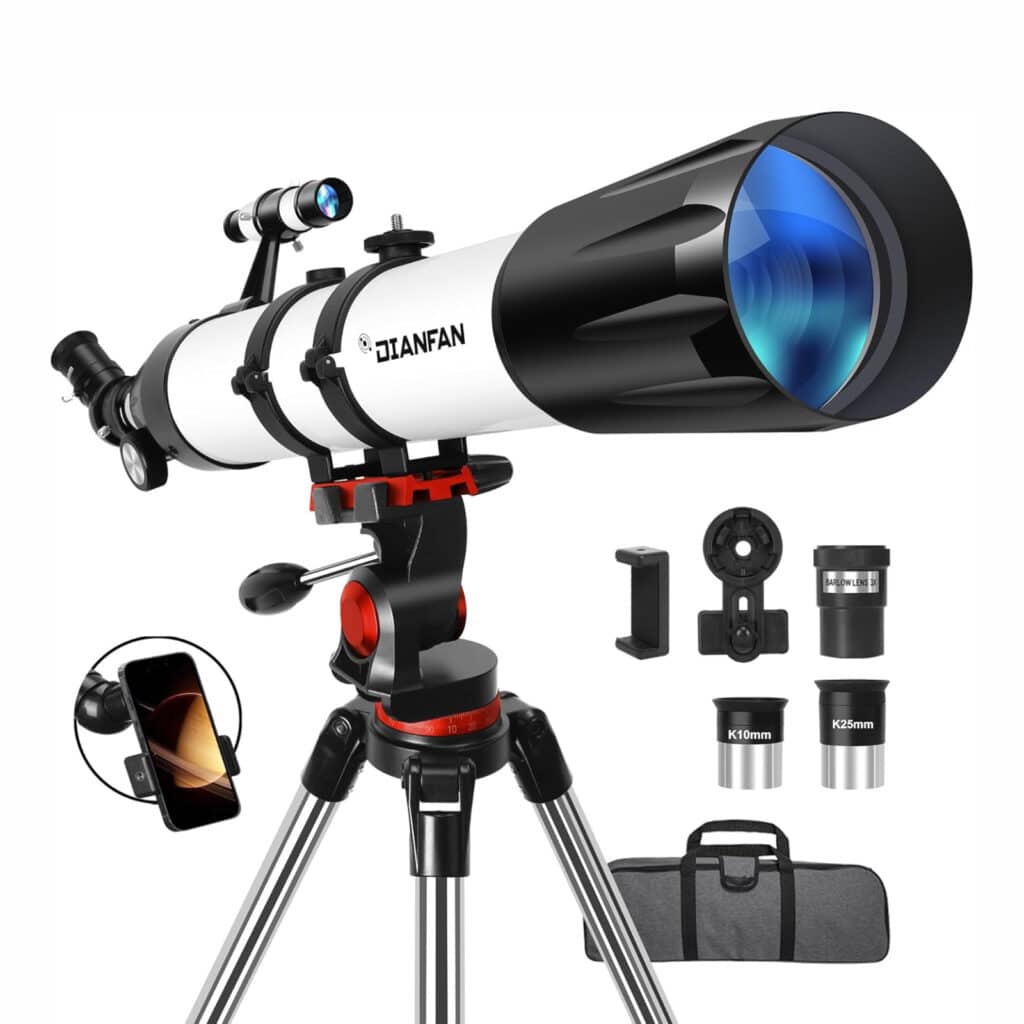
The Dianfan Telescope For Viewing Planets And Galaxies delivers impressive performance with its 90mm objective lens and 800mm focal length. This configuration provides an excellent balance between magnification capabilities and ease of use.
The telescope’s fully coated optics with high transmission coatings ensure superior light gathering and image clarity. With magnification options ranging from 32X to 240X through its included eyepieces and 3X Barlow lens, it offers versatility for various astronomical observations.
One of its most appealing aspects is its user-friendly design and quick setup process. The intuitive controls and straightforward assembly make it particularly attractive for those new to astronomy who don’t want to sacrifice optical quality.
The inclusion of a smartphone adapter and portable design adds modern convenience to traditional astronomical observation capabilities.
Pros
- High-quality 90mm objective lens
- Wide magnification range
- Excellent light transmission
- Portable design
- Quick setup process
- Comprehensive accessory kit
- Smartphone compatibility
Cons
- Limited advanced features
- Basic mount system
PICK #4
Rating
7.8/10
GENERAL VIEW
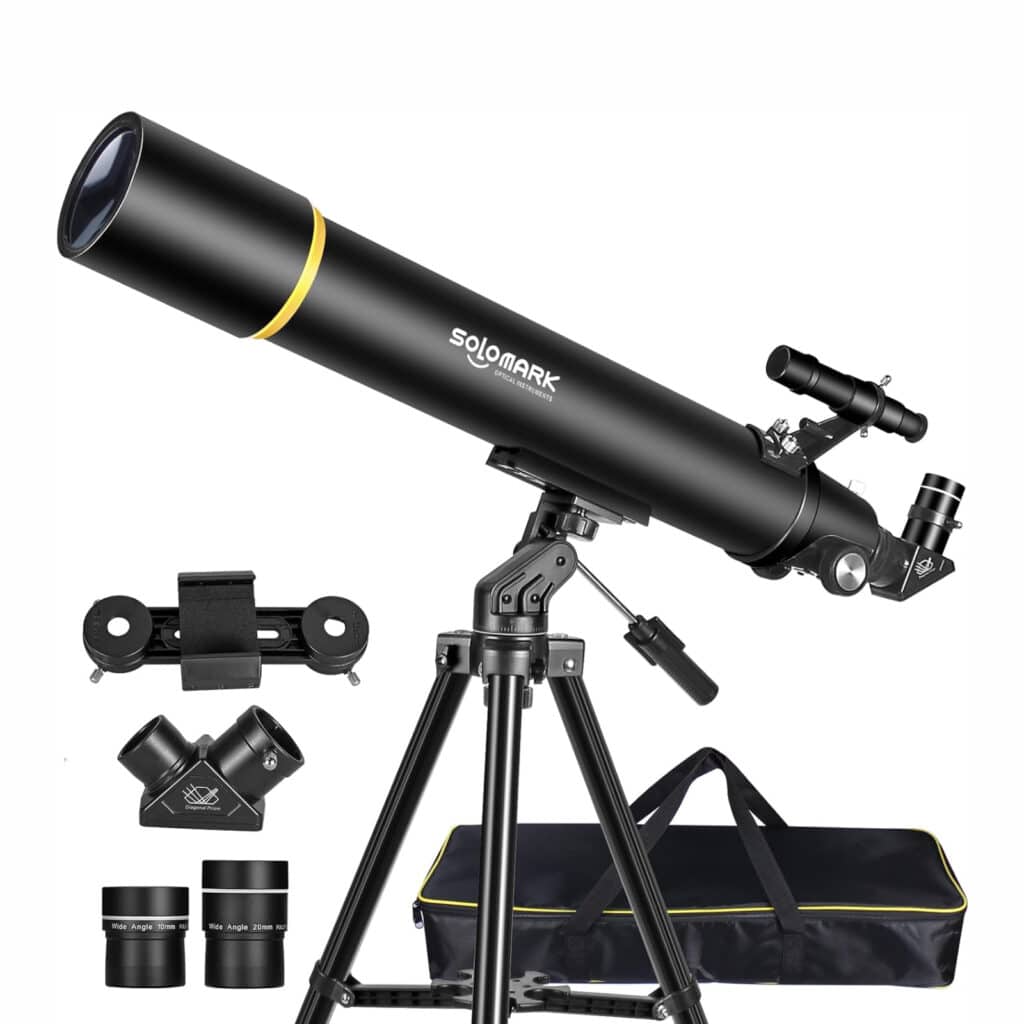
The Solomark Telescope For Viewing Planets And Galaxies distinguishes itself with an 80mm aperture and fully coated green optics glass lens. This professional-grade instrument emphasizes quality in its fundamental components.
A notable feature is its Super Azimuth Gimbal system, combined with a robust aluminum tripod. This combination provides exceptional stability and precise positioning capabilities, making it easier to track celestial objects across the night sky.
The telescope comes equipped with high-quality WA eyepieces offering 45X and 90X magnification options. These specialized eyepieces provide excellent clarity for both terrestrial and astronomical viewing, making it a versatile choice for varied observational needs.
The attention to user experience is evident in its thoughtful design, which prioritizes ease of assembly and operation while maintaining professional-grade performance standards.
Pros
- Professional-grade 80mm aperture
- Superior Azimuth Gimbal system
- High-quality WA eyepieces
- Precise positioning system
- Excellent build quality
- Stable aluminum tripod
- Easy assembly process
Cons
- Limited magnification range
- Higher learning curve
- Fewer included accessories
PICK #5
Rating
7.1/10
GENERAL VIEW
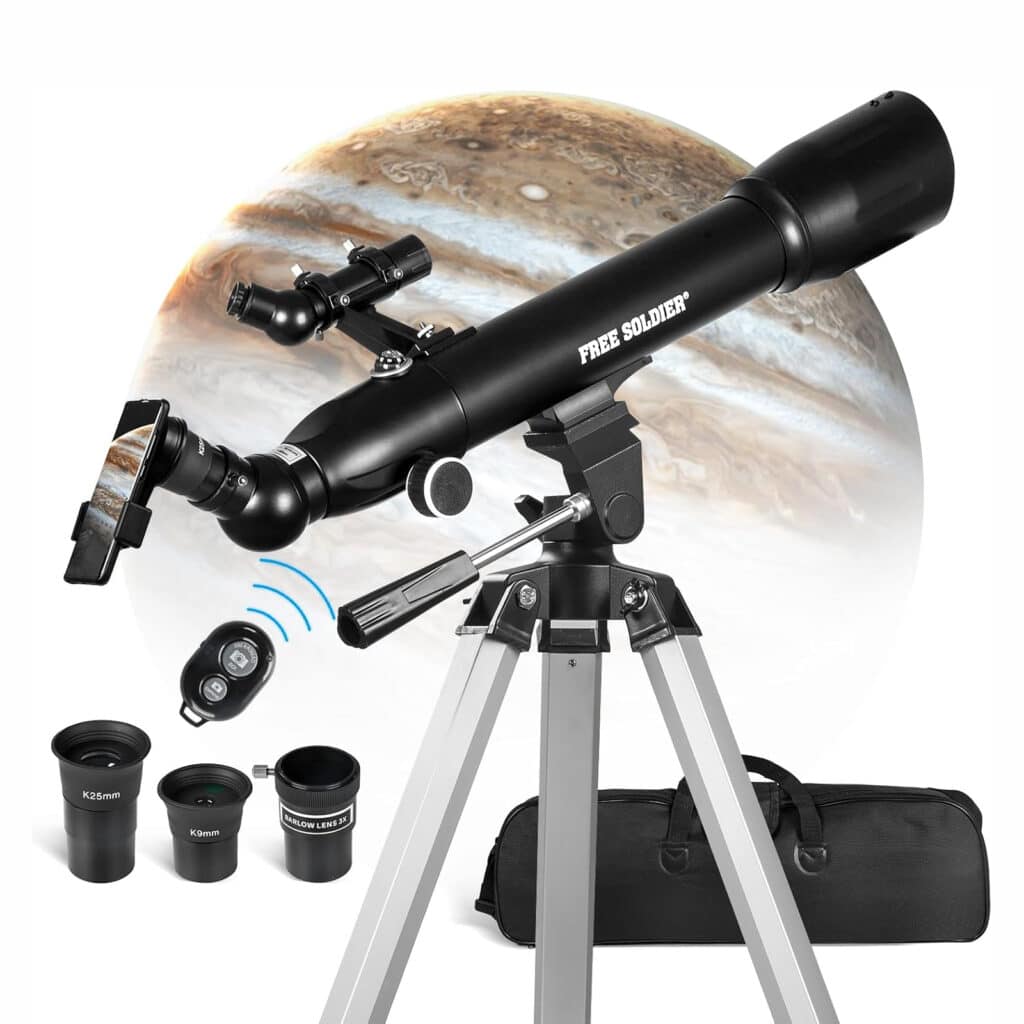
The Free Soldier Telescope For Viewing Planets And Galaxies offers impressive specifications with its 90mm aperture and 700mm focal length. This configuration provides excellent light-gathering capabilities for detailed celestial observations.
A distinguishing feature is its patented 360° Rotating Zenith Lens, which significantly enhances viewing comfort and flexibility. The telescope’s magnification range of 28X to 233X, achieved through K9mm and K25mm eyepieces, provides versatility for different viewing scenarios.
The inclusion of modern features like a universal phone adapter and wireless remote control makes it accessible for contemporary astronomy enthusiasts. These features facilitate easy documentation and sharing of observations.
While maintaining professional capabilities, this telescope places particular emphasis on user comfort and convenience, making it an attractive option for both serious observers and families.
Pros
- Large 90mm aperture
- Patented 360° rotating system
- Universal phone compatibility
- Premium K-series eyepieces
- Comprehensive accessory kit
- Strong customer support
Cons
- Basic tripod design
- Limited advanced features
- Heavier weight
- Complex initial setup
❓WHAT IS A TELESCOPE FOR VIEWING PLANETS AND GALAXIES
A telescope for viewing planets and galaxies is a specialized optical instrument designed to magnify distant celestial objects. These telescopes typically feature larger apertures (70mm-90mm+) and longer focal lengths to provide clear, detailed views of planets, star clusters, and deep-space objects. They often include specialized features like high-quality coatings, multiple eyepieces, and stable mounting systems to enhance astronomical observation capabilities.
⭐ Benefits of a Telescope For Viewing Planets And Galaxies
- Enhanced Visual Experience - Brings distant celestial objects into clear, detailed view
- Educational Value - Provides hands-on learning about astronomy and space science
- Photography Opportunities - Many models support astrophotography through smartphone integration
- Family Activity - Creates shared experiences for family stargazing sessions
- Scientific Observation - Enables detailed study of astronomical phenomena
- Portable Adventure - Many models are portable for different viewing locations
- Year-Round Use - Can be used in different seasons for various celestial events
- Long-Term Investment - Quality telescopes provide years of astronomical exploration
Things To Consider When Choosing a Telescope For Viewing Planets And Galaxies
- Aperture Size: Larger apertures (70mm+) gather more light for clearer images of distant objects and better performance in low-light conditions
- Focal Length: Choose a focal length appropriate for your viewing goals, typically 700mm+ for planetary observation and deep space viewing
- Mount Stability: A stable mount is crucial for clear viewing, especially at higher magnifications. Consider the mount type and construction quality
- Optical Quality: Look for fully multi-coated optics and quality prisms to ensure the best possible image clarity and light transmission
- Portability: Consider the telescope's weight and setup requirements if you plan to transport it to different viewing locations
- Included Accessories: Evaluate the quality and usefulness of included eyepieces, finders, and other accessories for your specific needs
- Digital Integration: Consider smartphone compatibility and digital features if you're interested in astrophotography or sharing observations
What To Avoid When Choosing a Telescope For Viewing Planets And Galaxies
- Unrealistic Claims: Be wary of products advertising extreme magnification capabilities that seem too good to be true
- Poor Mount Quality: Avoid telescopes with flimsy or unstable mounts, as they will significantly impact viewing quality
- Limited Accessories: Don't choose models lacking essential accessories like multiple eyepieces or finder scopes
- Cheap Optics: Avoid telescopes with uncoated or poorly coated optics, as they will provide inferior image quality

By Logan Chase – Research Specialist
After years of dedicated research and thorough examination of tech gadgets and tools, Logan has immersed himself in the realm of technology, acquiring extensive knowledge. Explore his expertise showcased in our prestigious Top 5 series.